How film music tells you what to feel before you know it
A recurring melody can announce a character before they appear. Composers have used the trick for more than a century, borrowed from opera.
The short version
- A leitmotif is a short musical theme tied to a character, place or idea.
- The technique is closely associated with Richard Wagner’s operas.
- John Williams’ Star Wars scores are a well-known film example.
- Silent-era films were usually shown with live music in the cinema.
Turn the sound off during a tense film scene and it often stops being tense. Music does a remarkable amount of emotional work in cinema, much of it without the audience noticing. It can tell you that a stranger is dangerous, that a quiet moment is about to break, or that a defeat is only temporary, sometimes several seconds before the pictures do.
Silent films were never silent
From the earliest days of cinema, films were shown with live music. Depending on the venue, that might mean a single pianist, a theatre organist or a full orchestra in a grand picture palace. Musicians often improvised or drew on existing pieces, and publishers produced cue sheets suggesting suitable music for particular kinds of scene: a chase, a storm, a tender reunion. The idea that music should follow, and steer, the mood of the pictures is as old as the medium itself.
When synchronised sound arrived in the late 1920s, studios could fix a score to the film itself. Within a few years composers were writing full original orchestral scores. Max Steiner’s music for King Kong (1933) is often cited as an early landmark, showing how much a dedicated score could add to a story that audiences knew was fantastical.
The leitmotif
A leitmotif is a short, recognisable musical idea linked to a character, place, object or feeling. Each time it returns, it brings its associations with it. The technique is most closely associated with the 19th-century composer Richard Wagner, whose operas weave dozens of such themes together. Wagner did not coin the term himself; it came into wide use through writers analysing his music.
Many composers of Hollywood’s studio era had trained in the European concert and opera tradition, so the approach came naturally to them. John Williams’ scores for the Star Wars films are a famous later example: individual characters and forces have their own themes, and the music can hint at who is about to appear, or who a character really is, before the story says so.
A theme does not have to be long or grand. Williams’ score for Jaws (1975) builds dread from little more than two alternating low notes, and for much of the film the music stands in for a shark the audience barely sees.
How a theme changes
A leitmotif is most powerful when it is transformed. Composers can slow it down, shift it from a major to a minor key, strip it back to a single instrument or break it into fragments. Viewers may not consciously recognise the change, but the familiar shape carries old associations into a new emotional setting. A heroic theme played softly and slowly can sound like grief; a love theme played in a distorted, uneasy harmony can suggest betrayal.
Other tools in the box
- Harmony. Unresolved or dissonant chords create unease; resolving them brings relief.
- Tempo and rhythm. A steady, insistent pulse can build tension even when nothing is happening on screen.
- Register. Very low notes can feel heavy or threatening; very high, sustained notes can feel fragile or eerie.
- Instrument choice. A solo instrument can make a scene feel intimate; a full orchestra can make it feel epic. Bernard Herrmann scored Psycho (1960) for strings alone, and its stabbing violins became one of the most imitated sounds in cinema.
- Mickey-mousing. Music that mirrors on-screen movement beat for beat, named after cartoon scoring. Used sparingly, it can be funny or thrilling; overused, it feels obvious.
- Silence. Dropping the music out entirely can be the most powerful choice of all.
How a score is made
The process differs from film to film, but it often runs roughly like this:
- Spotting. The composer watches a cut of the film with the director and decides where music should start and stop, and what each cue needs to do.
- Writing. Cues are composed to precise timings, so that musical moments land exactly with the picture.
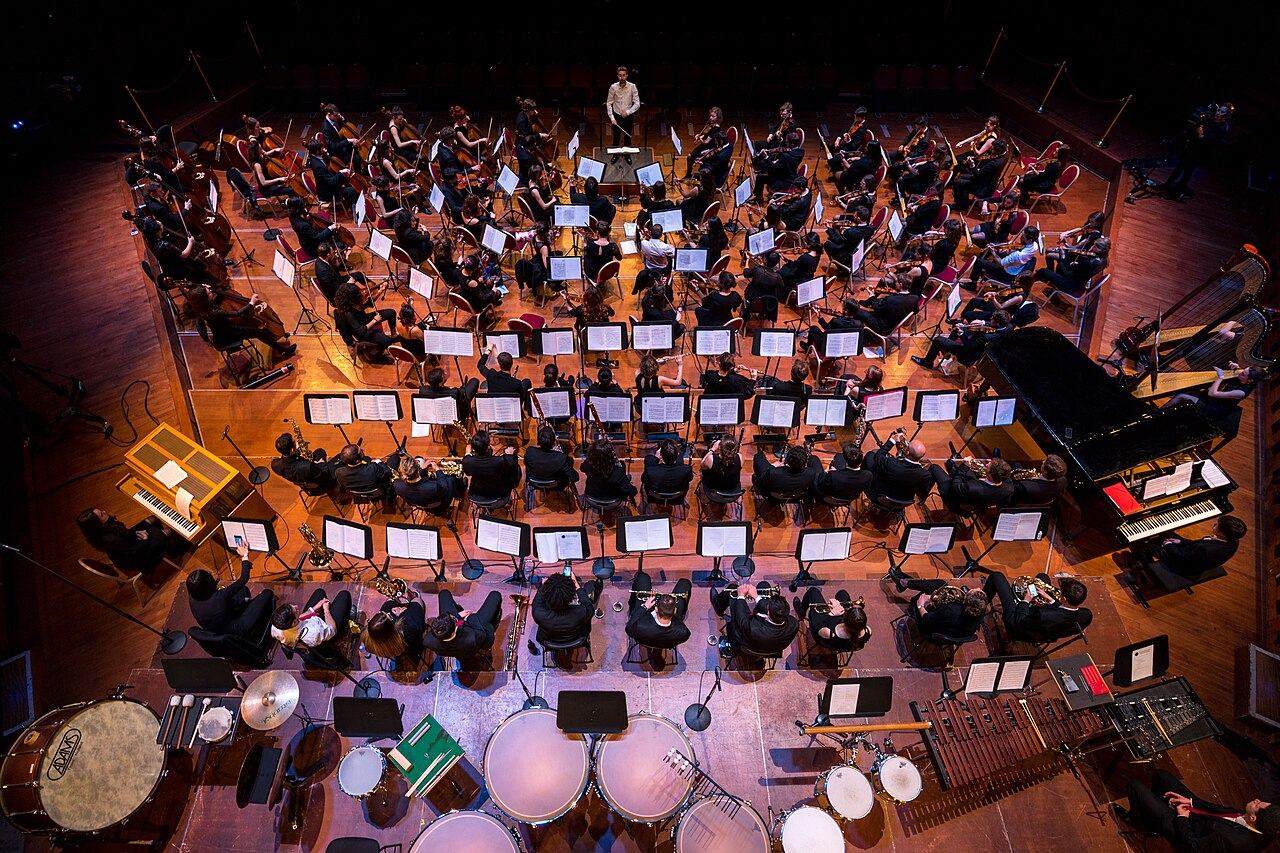
- Recording. A score may be played by an orchestra, built from synthesisers and samples, or a mixture of both. Musicians often play along to a click track to stay in sync.
- Mixing. Music is balanced against dialogue and sound effects. A beautiful cue may be turned right down so that a line can be heard.
Many directors edit with a temp track, borrowed music laid under scenes as a placeholder. It helps everyone understand what a scene needs, but composers sometimes find that a director has grown attached to the temporary music, which can make it harder for an original score to take its place.
Diegetic and non-diegetic music
Music that characters can hear, such as a radio playing in a scene, is called diegetic. Music only the audience hears is non-diegetic. Some of cinema’s most memorable moments play with the line between the two: a song that seems to be part of the soundtrack turns out to be coming from a car stereo, or a character hums a melody that the orchestra then picks up.
Common misconceptions
- “Good film music goes unnoticed.” Some scores work best in the background, but others are meant to be heard and remembered. Both can be excellent.
- “Every score needs a big tune.” Many effective modern scores rely on texture, rhythm and atmosphere rather than a melody you could hum.
- “Music simply follows the picture.” Editors sometimes cut scenes to the rhythm of the music, so influence can run in both directions.
What is still debated
Researchers continue to study how much of music’s emotional effect is universal and how much is learned. Some associations, such as certain scales sounding sad or bright, appear to depend partly on the musical culture a listener grew up with. Film music may teach those associations to audiences as much as it relies on them.
Try this
Next time you watch a film, listen for a theme that returns. Notice when it first appears, and how it changes: slower, in a minor key, or played on a different instrument. Those changes are often the composer telling you how the story has changed.
Test yourself
3 quick questions on what you just read. Your answers stay on your device.
Sources and further reading
We check our facts after publication too. If you spot an error, please tell us. Any correction will be noted here, as set out in our corrections policy.