Inside the James Webb Space Telescope
A gold-coated mirror, a sunshield the size of a tennis court and an orbit 1.5 million kilometres away: how Webb sees the early universe.
The short version
- Webb launched on 25 December 2021.
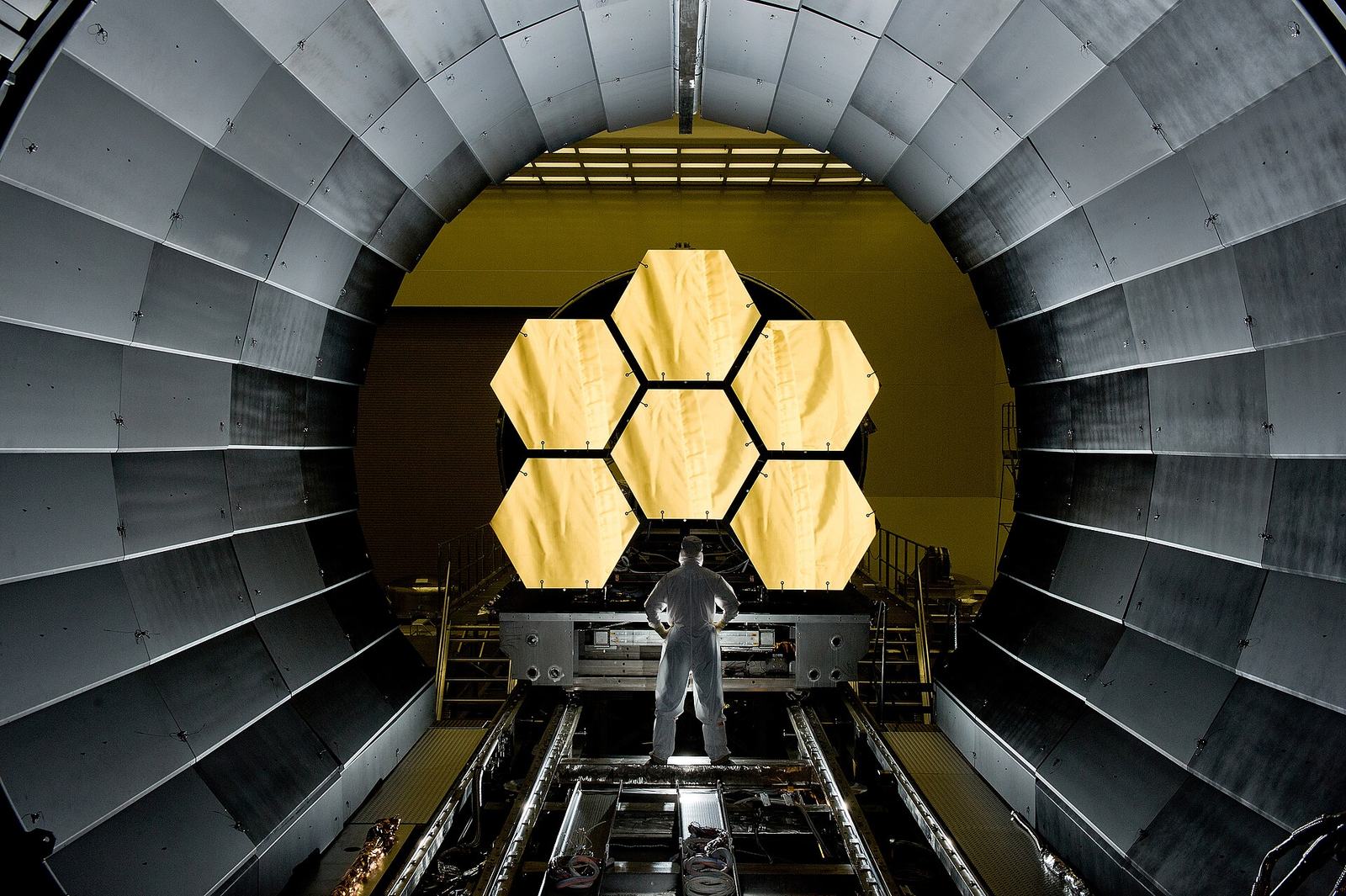
- Its primary mirror is 6.5 metres across, made of 18 hexagonal segments.
- It observes mainly in infrared light from a point about 1.5 million km from Earth.
- Webb complements Hubble rather than replacing it: Hubble sees mainly visible and ultraviolet light.
The James Webb Space Telescope, a partnership between NASA, the European Space Agency and the Canadian Space Agency, is the largest space telescope ever launched. It was built to see farther back in time than any before it.
It is named after James E. Webb, who led NASA during much of the 1960s, the years that built up to the Apollo Moon landings. Planning for a successor to the Hubble Space Telescope began decades before launch, and the project went through long delays and large cost increases before it finally flew.
Why infrared
Light from the most distant galaxies has been travelling for billions of years. As the universe expands, that light is stretched to longer wavelengths, shifting it from visible light into the infrared. Infrared light also passes through dust that blocks visible light, revealing stars as they form. Webb is designed mainly to see infrared.
Because light takes time to travel, looking at distant objects means looking into the past. Webb sees the earliest galaxies as they were when the universe was a small fraction of its current age.
The mirror
Webb’s primary mirror is 6.5 metres across, far larger than Hubble’s 2.4 metres. It is too big to launch in one piece, so it is made of 18 hexagonal segments of beryllium coated with a thin layer of gold, which reflects infrared light very well. The mirror was folded for launch and unfolded in space.
Each segment can be moved by tiny motors. After launch, engineers spent months adjusting them, step by step, until the 18 segments behaved as a single, precisely shaped mirror.
Keeping cold
Infrared telescopes must be extremely cold, or their own heat would swamp the faint signals. Webb carries a five-layer sunshield about the size of a tennis court that blocks heat from the Sun, Earth and Moon, keeping the instruments far below freezing.
The layers are made of a thin, coated plastic film, separated by gaps so that heat radiates out sideways between them. Most of Webb’s instruments are cooled passively by the shield. Its mid-infrared instrument, which needs to be colder still, has its own refrigerator, called a cryocooler.
The instruments
Webb carries four main science instruments:
- NIRCam, its main near-infrared camera, which takes many of the best-known images.
- NIRSpec, a spectrograph that splits light into its component wavelengths, and can observe many objects at once.
- MIRI, which works at longer, mid-infrared wavelengths, useful for dust, cooler objects and distant galaxies.
- NIRISS, paired with a fine guidance sensor that keeps the telescope pointing steadily.
Spectra are often more valuable to scientists than pictures. Splitting light into its wavelengths reveals what an object is made of, how hot it is and how fast it is moving.
Getting there
Webb launched on 25 December 2021 on an Ariane 5 rocket from Europe’s spaceport in French Guiana. What followed was one of the most complicated deployments ever attempted:
- Launch and cruise. The telescope was folded inside the rocket’s nose fairing and began a journey of about a month to its destination.
- Unfolding. Over the first weeks, the sunshield was unfurled and tensioned, and the secondary mirror and the wings of the primary mirror swung into place.
- Alignment. Over the following months, engineers aligned the mirror segments and tested and calibrated the instruments.
- Science. The first full-colour images were released in July 2022.
Where it is
Webb orbits a point in space called the second Lagrange point, or L2, about 1.5 million kilometres from Earth on the side away from the Sun. There, it can keep the Sun, Earth and Moon behind its shield all the time.
That distance has a cost. Hubble, in low Earth orbit, was visited and repaired by Space Shuttle astronauts several times. Webb is far beyond the reach of any crewed spacecraft, so it had to work first time. Because its launch was so accurate, it saved fuel, and NASA has said it should have enough to operate well beyond its originally planned mission length.
What it has shown
Since its first images were released in July 2022, Webb has observed some of the earliest galaxies yet seen, studied the atmospheres of planets around other stars and captured detailed images of nebulae where stars are being born. Among its early results was a clear detection of carbon dioxide in the atmosphere of a giant planet orbiting another star.
Common misconceptions
- “Webb replaced Hubble.” Hubble is still working. It sees mainly visible and ultraviolet light, while Webb specialises in infrared, so the two complement each other.
- “The colours in Webb images are what you would see.” Infrared light is invisible to human eyes. Image processors assign visible colours to different infrared wavelengths, usually with shorter wavelengths shown as bluer.
What is still uncertain
Some of Webb’s observations have raised new questions. It has found early galaxies that appear brighter or more numerous than many models predicted, and researchers are still debating how to interpret them. Its measurements also feed into a long-running disagreement about how fast the universe is expanding. These are open scientific problems, and Webb is likely to keep contributing to them for years to come.
Test yourself
3 quick questions on what you just read. Your answers stay on your device.
Sources and further reading
We check our facts after publication too. If you spot an error, please tell us. Any correction will be noted here, as set out in our corrections policy.