Why the sky is blue, and sunsets are red
Sunlight contains every colour. Air scatters the blue part far more than the red, and that one fact explains both the daytime sky and the evening glow.
The short version
- Sunlight is a mix of all visible colours.
- Air molecules scatter short (blue) wavelengths much more than long (red) ones.
- At sunset, light crosses more air, so more blue is scattered away.
- Clouds look white because their water droplets scatter all colours roughly equally.
Look at sunlight through a prism and it splits into a rainbow. All those colours are in the light that reaches the top of our atmosphere. What happens next decides the colour of the sky.
It is one of the oldest questions children ask, and the answer turns out to explain a surprising amount: blue skies, red sunsets, white clouds, black skies in space and even the colour of the sky on Mars.
A question with a long history
People have offered explanations for the blue sky for centuries. Some thought it was the colour of air itself, or a reflection of the sea. In the nineteenth century, the Irish physicist John Tyndall showed in laboratory experiments that tiny particles suspended in a gas scatter blue light more than red. Lord Rayleigh then worked out the mathematics, showing that even individual gas molecules, far too small to see, would scatter light in exactly this colour-dependent way.
Scattering
As sunlight passes through the air, it hits gas molecules, mostly nitrogen and oxygen, that are much smaller than the wavelength of light. These molecules scatter light in all directions, and they scatter shorter wavelengths far more strongly than longer ones. This effect is called Rayleigh scattering, after the physicist Lord Rayleigh.
The strength of the effect rises steeply as wavelength gets shorter: halve the wavelength and scattering increases sixteen-fold. Blue light has a shorter wavelength than red, so it is scattered several times more. When you look at any part of the sky away from the Sun, you are seeing sunlight that has been bounced towards you by the air, and it is dominated by blue.
Following a beam of light
It helps to trace what happens step by step:
- Sunlight arrives. White light, containing all colours, enters the top of the atmosphere.
- Blue is redirected. As it travels down, a small fraction of the blue light is knocked sideways by air molecules, far more than the red.
- The sky fills with blue. That scattered blue light bounces around, and some of it heads towards your eyes from every direction.
- The direct beam changes slightly. Because some blue has been removed, the Sun itself looks a little more yellow than it would from space.
Why not violet?
Violet light is scattered even more than blue. But sunlight contains less violet, some is absorbed high in the atmosphere, and our eyes are less sensitive to it. The combined result looks blue to us.
Red and orange sunsets
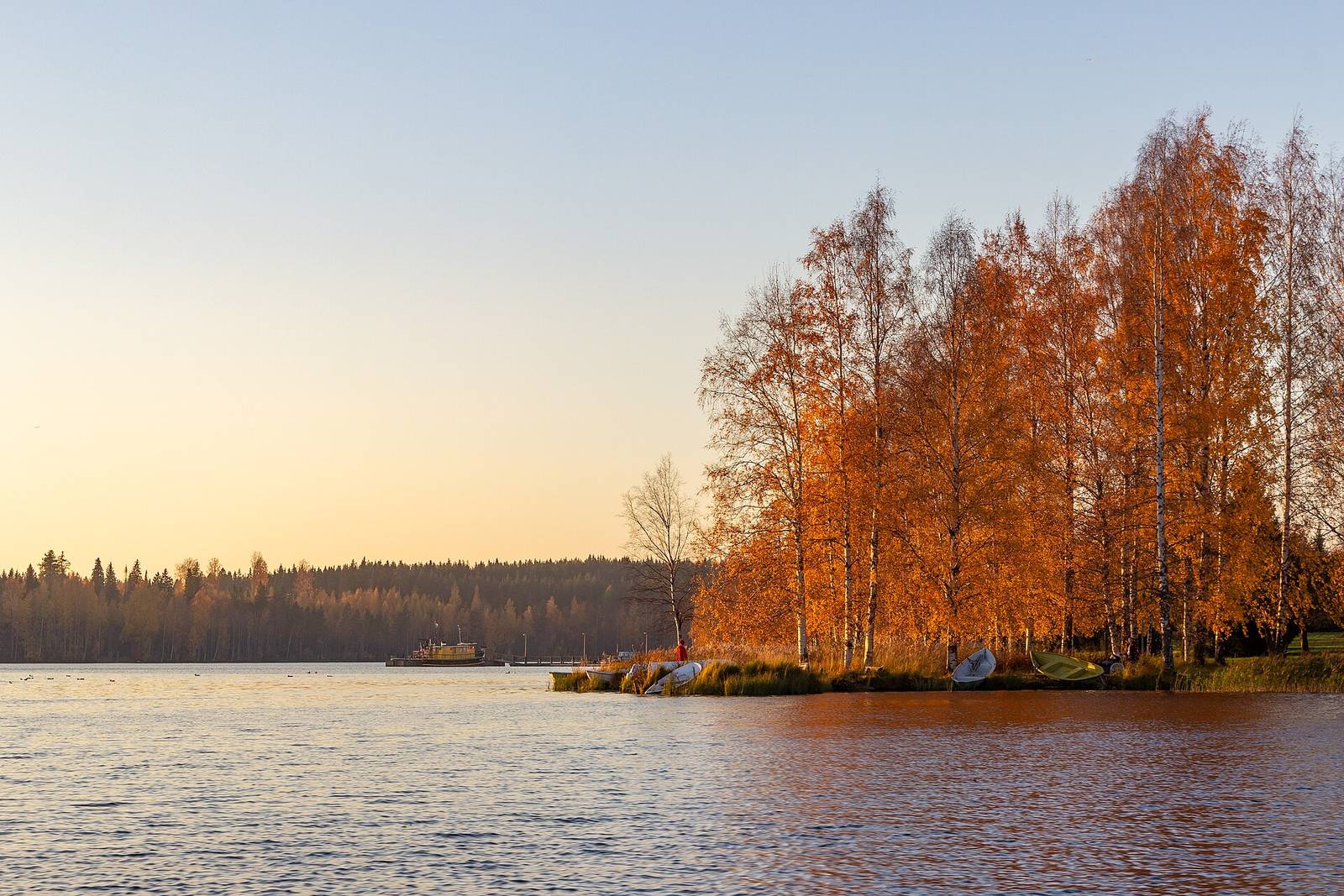
When the Sun is low, its light travels through much more atmosphere to reach you. Along that long path, most of the blue is scattered out of the direct beam, leaving the reds and oranges. Dust, smoke and other particles in the air can make sunsets even more vivid. After large volcanic eruptions, such as Krakatoa in 1883, fine particles high in the atmosphere produced unusually colourful sunsets around the world.
The same idea explains why the sky near the horizon usually looks paler than the sky overhead. Light reaching you from near the horizon has passed through much more air and has been scattered many times, which mixes the colours back towards white.
Why clouds are white
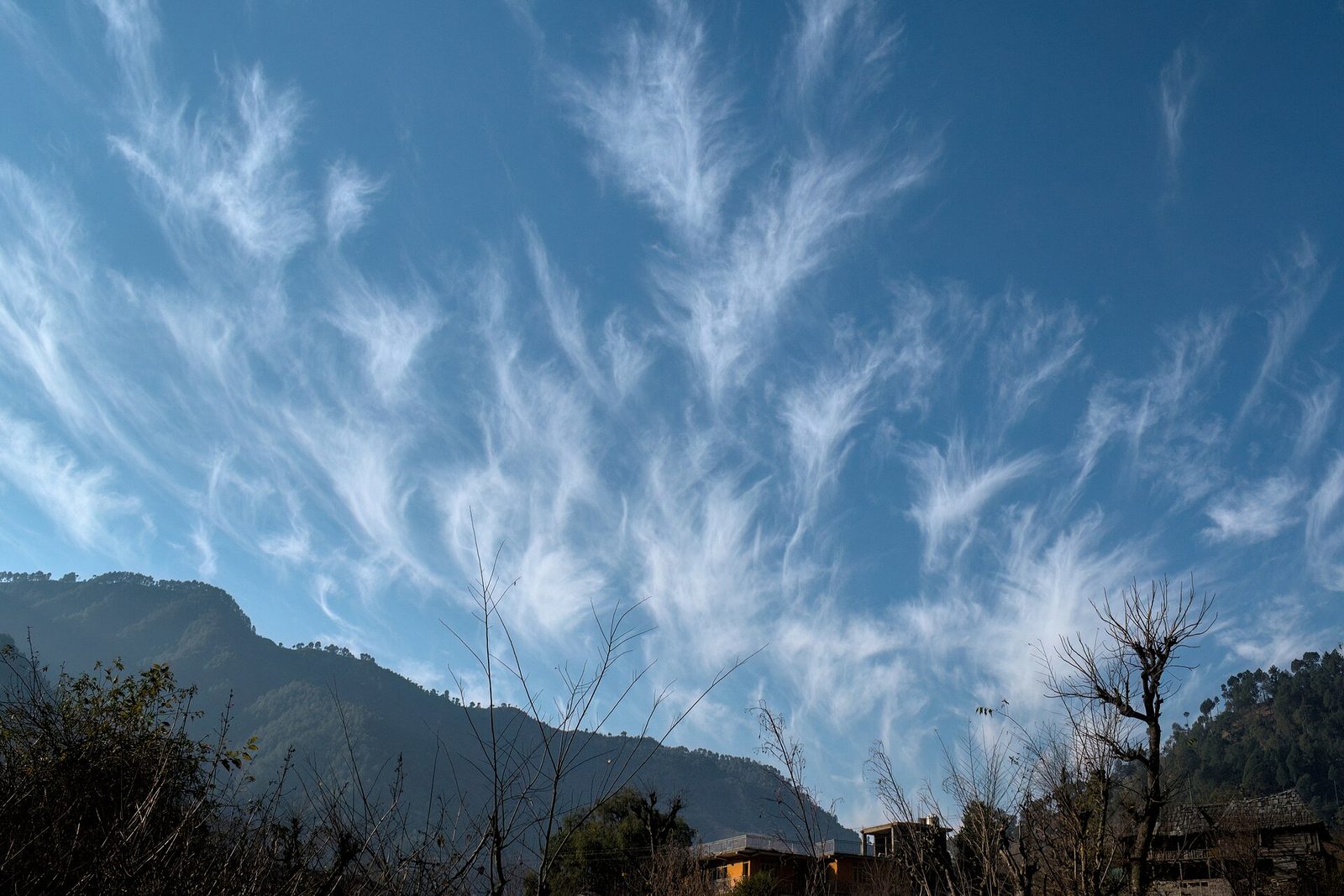
Cloud droplets are much larger than air molecules, comparable to or bigger than the wavelength of light. Particles that size scatter all visible colours roughly equally, so clouds look white. Thick clouds look grey or dark from below because less light makes it all the way through them.
Common misconceptions
- “The sky reflects the ocean.” It does not. The sky is blue over deserts and far inland. If anything, the sea’s colour comes partly from reflecting the sky, and partly from water’s own slight tendency to absorb red light.
- “Air is blue.” A glass of air is colourless. It takes many kilometres of atmosphere for the scattered blue light to add up to a visible colour.
- “Space is dark because there is no light there.” Sunlight fills space near Earth. Space looks black because there is no air to scatter that light towards your eyes, which is why astronauts on the Moon saw a black sky even in daytime.
On other worlds
The same physics plays out differently elsewhere. On Mars, fine dust in the thin atmosphere gives the daytime sky a butterscotch tint, and sunsets there can look bluish, as images from NASA’s rovers have shown. The dust particles there scatter light in a different way from the small molecules in Earth’s air.
What it means for you
Scattered skylight is also partly polarised, meaning its light waves tend to vibrate in a particular direction. That is why polarising sunglasses and camera filters can darken a blue sky. It is one small, everyday sign of the physics overhead.
Test yourself
3 quick questions on what you just read. Your answers stay on your device.
Sources and further reading
We check our facts after publication too. If you spot an error, please tell us. Any correction will be noted here, as set out in our corrections policy.