How the UN Security Council works, and why one “no” can stop it
Fifteen countries sit at the table, but five of them can block any decision on their own. Here is how the world’s most powerful diplomatic body really operates.
The short version
- The Council has 15 members: five permanent, ten elected for two-year terms.
- Any of the five permanent members can veto a substantive resolution.
- Its resolutions can be legally binding on all UN member states.
- Elected members cannot be re-elected for the term immediately after their own.
The United Nations Security Council is the only UN body whose decisions member states are obliged to carry out. It can impose sanctions, authorise peacekeeping missions and, in the most serious cases, approve the use of force. That power is why its membership and voting rules matter so much.
Where the Council came from
The Council was created by the UN Charter, which was signed in San Francisco in June 1945 and came into force in October of that year. Its designers had watched the League of Nations fail to stop the slide into the Second World War. One lesson they drew was that an international organisation needed the great powers inside it, committed to its decisions, and that it needed the ability to act rather than merely to recommend.
The Charter gives the Council “primary responsibility for the maintenance of international peace and security”. Under Article 25, UN members agree to accept and carry out its decisions. No other part of the UN system has that kind of authority over states.
Who sits on the Council
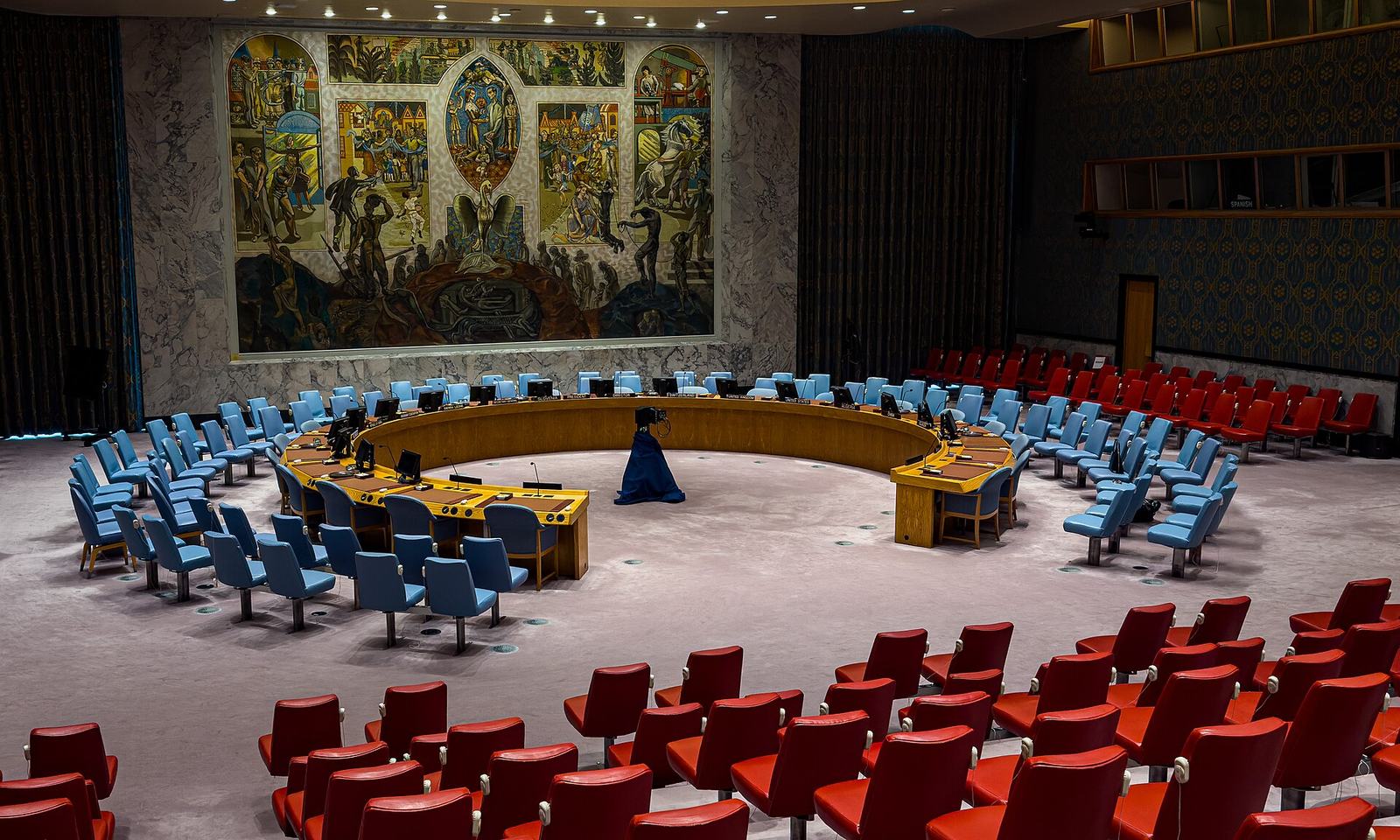
There are 15 seats. Five belong permanently to the countries that emerged as the main victors of the Second World War: China, France, Russia, the United Kingdom and the United States. The other ten are elected by the UN General Assembly for two-year terms, five each year, with seats shared out between regions.
The Council has not always looked like this. It began with 11 members, six of them elected, and was enlarged to 15 by a Charter amendment that took effect in 1965, as decolonisation swelled the UN’s membership. Two permanent seats have also changed hands without the Charter text changing: in 1971 the General Assembly recognised the People’s Republic of China as the holder of China’s seat, which had been occupied by the government in Taipei, and in 1991 Russia took over the seat of the Soviet Union.
Elected members need a two-thirds majority in the General Assembly, and an outgoing member cannot be re-elected straight away. The presidency of the Council rotates every month, in English alphabetical order of member names.
How a decision is made
Most decisions need nine “yes” votes out of 15. For anything beyond procedure, there is a second condition: none of the five permanent members may vote against it. A single “no” from one of them is a veto, and the resolution fails even if the other 14 support it.
- Abstaining is not a veto. By long-standing practice, a permanent member that abstains does not block a resolution.
- Procedural votes are different. Questions such as adopting the agenda need nine votes, and the veto does not apply.
A typical resolution moves through several stages:
- A member, often called the “penholder” on a particular topic, circulates a draft.
- Members negotiate the wording in private consultations, sometimes for weeks.
- The final text is put in blue ink, a signal that it is ready for a vote.
- The Council votes in a public meeting, and members may explain their positions.
Much of the real work happens in steps one to three. A draft that is expected to be vetoed is sometimes softened until it can pass, or withdrawn, or put to a vote anyway to make a political point.
What the Council can actually do
The Charter sets out a ladder of tools. Under Chapter VI, the Council can call on parties to settle a dispute peacefully and recommend ways to do so. Under Chapter VII, if it finds a threat to the peace, a breach of the peace or an act of aggression, it can order measures such as economic sanctions or arms embargoes, and it can authorise military action.
Peacekeeping, perhaps the UN’s best-known activity, is not mentioned by name in the Charter. It grew up in practice, and the Council creates and renews each mission with its own mandate.
Common misconceptions
- The UN does not have its own army. Peacekeepers are troops and police contributed by member states, and enforcement action relies on states willing to act.
- General Assembly resolutions are a different thing. Every UN member has a vote in the Assembly, but its resolutions on most matters are recommendations, not binding orders.
Why the veto is so contested
Supporters argue that the veto keeps the major powers inside the system. Without it, they say, the UN could take decisions that its most powerful members would simply ignore, as happened to the League of Nations before it.
Critics argue that the veto lets a permanent member shield itself or its allies from action, and that a membership list fixed in 1945 no longer reflects the world. Proposals for reform, such as adding permanent seats, have been debated for decades. Any change to the UN Charter needs the approval of two-thirds of UN members, including all five permanent members, which is why reform has proved so hard.
There have been smaller changes in practice. Since 2022 the General Assembly has committed to meeting whenever a veto is cast, so that the country using it can be asked to explain its decision in front of the wider membership. That does not overturn a veto, but it adds a public cost to using one.
What is still uncertain
The shape of any future reform remains open. Countries disagree about which states, or regions, should gain seats, whether new members should have a veto, and whether the existing veto should be limited in some situations. Until the permanent members themselves agree, the 1945 structure is likely to remain.
What to watch in coverage
When you read about a Council vote, three details tell you most of the story: how many members voted in favour, whether any permanent member voted against, and who abstained. A resolution that passes 15–0 sends a very different signal from one that passes 9–0 with six abstentions.
It is also worth checking which chapter of the Charter a resolution relies on. Language invoking Chapter VII usually signals that the Council intends its decision to be binding, while softer wording that “calls upon” parties to act may carry less weight.
Test yourself
3 quick questions on what you just read. Your answers stay on your device.
Sources and further reading
We check our facts after publication too. If you spot an error, please tell us. Any correction will be noted here, as set out in our corrections policy.