What a time zone map reveals about the countries on it
Time zones look like a tidy science. In reality they are political decisions, and some of them are surprising.
The short version
- Time zones are set by governments, not by geography alone.
- China spans about five geographic time zones but uses one official time.
- India uses UTC+5:30 and Nepal UTC+5:45.
- Standard time zones spread in the late 19th century, largely because of railways.
In theory, the world divides neatly into 24 time zones, each one hour apart and roughly 15 degrees of longitude wide. In practice, each country decides its own time, and the decisions say a lot about history and politics.
Before time zones
For most of history, every town kept its own time. Noon was when the sun stood highest overhead, so a town a little to the west had a clock running a few minutes behind its neighbour to the east. Nobody minded, because few people travelled fast enough to notice.
Railways changed that. A timetable is hard to print when every station keeps a different time. In Britain, railway companies in the 1840s began running their trains on Greenwich time, and towns gradually followed. In North America, the railways introduced a system of standard time zones in 1883, replacing dozens of local times.
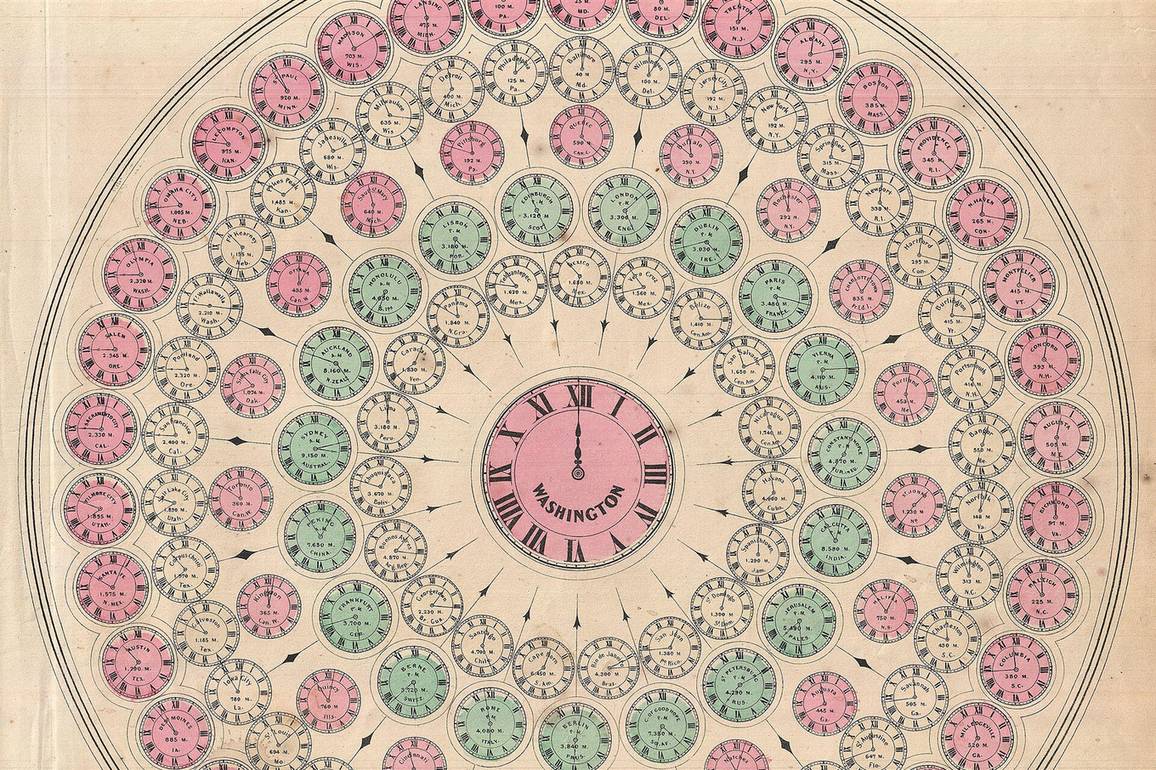
In 1884 delegates from many countries met at the International Meridian Conference in Washington and agreed to use the meridian passing through Greenwich, in London, as the starting point for measuring longitude. That made Greenwich the reference for the world’s clocks. Today the reference is Coordinated Universal Time, or UTC, kept by atomic clocks, and every zone is described as an offset from it.
How the system works
The basic idea is simple. The Earth turns 360 degrees in 24 hours, or 15 degrees an hour. A zone centred on a meridian that is a multiple of 15 degrees will have local noon close to 12:00 on the clock.
Governments then bend that grid to suit themselves. Borders follow national and regional boundaries rather than straight lines, and a country can choose an offset that does not match its longitude at all.
One country, one clock
China stretches across roughly five geographic time zones, yet the whole country officially runs on Beijing time, eight hours ahead of Coordinated Universal Time (UTC). In the far west, that means the sun can rise very late in the morning by the clock. Many people in the region organise daily life around a local, unofficial time as well.
India, which is also wide, uses a single zone too: UTC+5:30, a half-hour offset that splits the difference across the country.
Other large countries take the opposite approach. Russia spans 11 time zones, and the contiguous United States uses four main ones. A single national time can be a statement of unity; several zones keep the clock closer to the sun.
Half and quarter hours
Not every zone sits on the hour.
- India uses UTC+5:30.
- Nepal uses UTC+5:45, one of the few quarter-hour offsets in use.
- Parts of Australia, including South Australia, use half-hour offsets.
New Zealand’s Chatham Islands go further, keeping a time 45 minutes ahead of the main islands of the country.
Clocks set by neighbours
Some of the most interesting choices have more to do with trade and politics than with the sun.
- Spain sits largely on the same longitude as Britain, yet it uses Central European Time, the same as France and Germany. The country moved its clocks forward in 1940 and has stayed there since, which is one reason Spanish evenings feel so long and light.
- Samoa skipped a whole day at the end of December 2011, jumping from one side of the International Date Line to the other. The change put it on the same working week as Australia and New Zealand, its main trading partners.
- Kiribati, which spans a vast area of the Pacific, moved the date line in the 1990s so that the whole country would share the same date. Its easternmost islands now use UTC+14, among the first places on Earth to start each new day.
Clocks that change
Many countries shift their clocks for daylight saving time in summer, while others never do. Countries near the equator gain little from it, because day length barely changes through the year. Some places have adopted daylight saving and later abandoned it, which is why “what time is it there?” can have a different answer in March than in October.
Germany was among the first countries to adopt summer time nationally, during the First World War, as a way to save fuel. The practice has been argued about ever since. Supporters point to lighter evenings; opponents point to disrupted sleep and question whether energy savings are meaningful today. In the United States, most of Arizona does not change its clocks at all.
Common misconceptions
- There are not exactly 24 zones. Because of half-hour and quarter-hour offsets and the date line, there are many more distinct local times in use.
- GMT and UTC are not quite the same thing. In everyday use they show the same time, but UTC is the scientific standard based on atomic clocks, while GMT is also the name of a time zone.
- Time zones are not fixed. Governments change them, sometimes at short notice, and software has to be updated to keep up.
What it means for you
If you work with people in other countries, the safest habit is to name meetings by a specific city or by UTC, not by a vague label such as “Eastern time”. Twice a year, when some countries change their clocks and others do not, the gap between two places can shift by an hour for a few weeks.
Reading the map
When you look at a time zone map, the jagged lines are the interesting part. A border that bends to keep a country on one clock, or an offset of 30 or 45 minutes, usually marks a deliberate choice about national identity, trade partners or daily routine.
Test yourself
3 quick questions on what you just read. Your answers stay on your device.
Sources and further reading
We check our facts after publication too. If you spot an error, please tell us. Any correction will be noted here, as set out in our corrections policy.