How black holes form, and how we finally photographed one
Nothing can escape a black hole, not even light. In 2019, a network of telescopes the size of Earth produced the first image of one.
The short version
- Stellar black holes form when very massive stars collapse.
- The edge beyond which nothing escapes is called the event horizon.
- The Event Horizon Telescope released the first image of a black hole in April 2019.
- The Sun is not massive enough to become a black hole.
A black hole is a region where gravity is so strong that nothing, not even light, can escape once it crosses a boundary called the event horizon. That makes black holes invisible in themselves, but very visible in their effects.
They were once a mathematical curiosity. Today they are among the most closely studied objects in the universe, and we have pictures of two of them.
From theory to reality
Black holes come out of Albert Einstein’s general theory of relativity, published in 1915, which describes gravity as the bending of space and time by mass. Within months, the German physicist Karl Schwarzschild found a solution to Einstein’s equations describing the space around a single, compact mass. It implied a radius within which nothing could escape.
For decades many physicists, Einstein included, doubted that nature would actually produce such objects. That changed in the 1960s and 1970s, as theoretical work showed that collapse to a black hole was hard to avoid for very massive stars, and as astronomers found strong candidates. The name “black hole” was popularised in the late 1960s by the American physicist John Wheeler. One of the earliest widely accepted examples was Cygnus X-1, an X-ray source in which a star orbits an unseen, massive companion.
How they form
Stars shine by fusing light elements into heavier ones in their cores. When a very massive star runs out of fuel, its core can no longer support itself against its own gravity and collapses. If enough mass remains, the collapse continues until a black hole forms, often accompanied by a supernova explosion of the star’s outer layers.
Step by step, the life of such a star looks like this:
- Fusion holds it up. The outward pressure from energy released in the core balances the inward pull of gravity.
- The fuel runs low. The star fuses heavier and heavier elements, each stage lasting a shorter time.
- The core fails. Once the core is mostly iron, fusion no longer releases energy, and nothing holds the core up.
- Collapse. The core falls in on itself in a fraction of a second. Depending on its mass, it becomes either an extremely dense neutron star or, if heavy enough, a black hole.
These stellar black holes typically have a few to a few dozen times the mass of the Sun. At the centres of most large galaxies are far bigger supermassive black holes, with millions or billions of solar masses. How those giants grew so large is still an active research question.
Not every star ends this way. The Sun is far too light. In billions of years it is expected to swell into a red giant and end as a white dwarf, a dense, slowly cooling stellar remnant.
Seeing the invisible
Gas falling towards a black hole forms a swirling disk that heats up and glows. Astronomers can also detect black holes from the way they pull on nearby stars, and from gravitational waves, ripples in space-time first detected directly in 2015 when two black holes merged. That detection, by the LIGO observatories in the United States, led to the 2017 Nobel Prize in Physics.
Watching stars move around the centre of our own galaxy over many years gave some of the strongest evidence for a supermassive black hole there, weighing about four million times the mass of the Sun. Reinhard Genzel and Andrea Ghez, who led two of the teams behind that work, shared the 2020 Nobel Prize in Physics with Roger Penrose, honoured for his theoretical work on black hole formation.
The first image
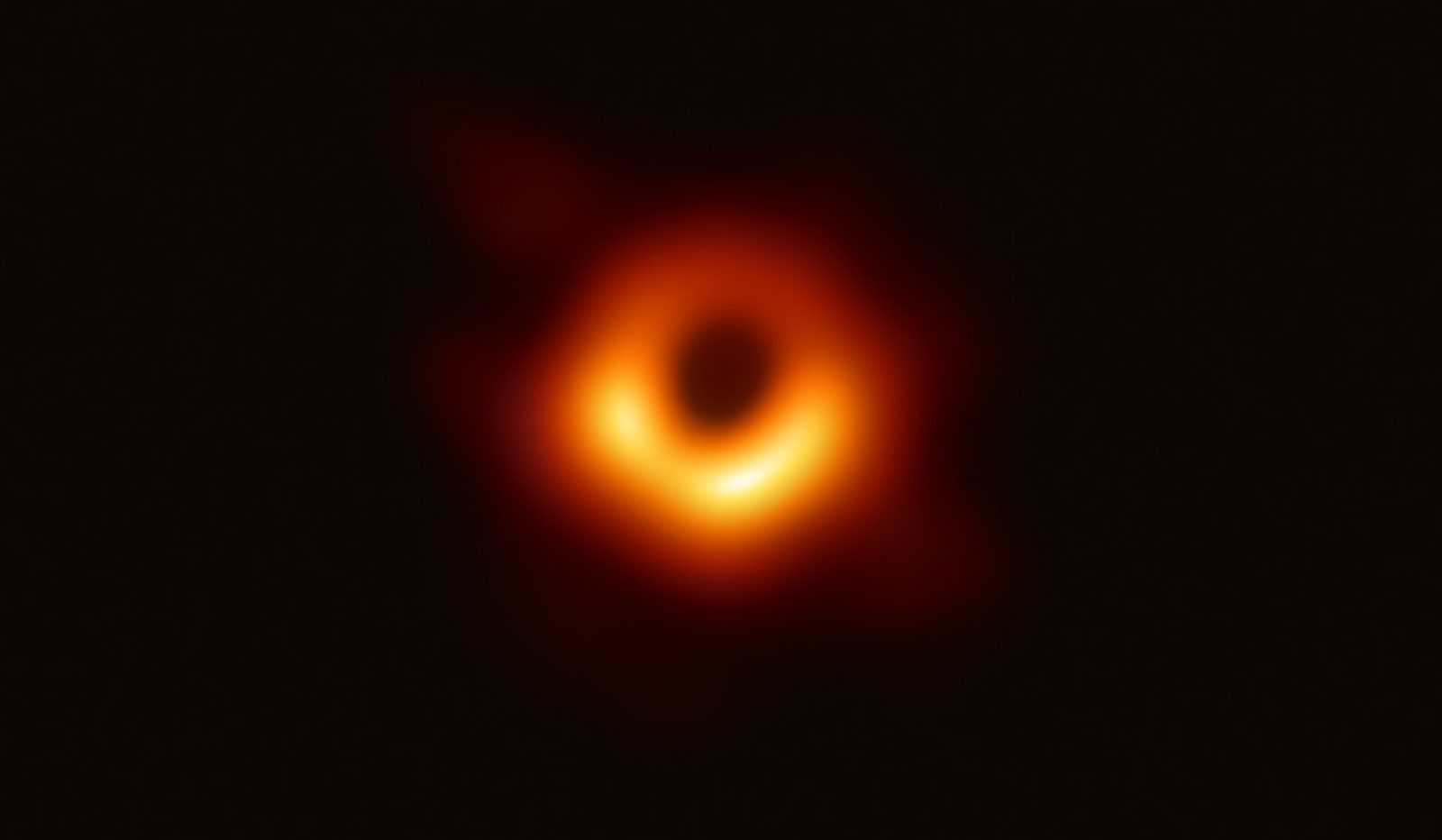
In April 2019, the Event Horizon Telescope collaboration released the first image of a black hole: the supermassive black hole at the centre of the galaxy M87, about 55 million light-years away. It showed a bright ring of glowing gas around a dark centre, the black hole’s shadow.
The telescope is not one instrument. It links radio observatories around the world so that, together, they work like a single dish the size of Earth. Each site records its data with precise atomic clocks, and the recordings are later combined by computers. The image required years of analysis by a large international team. In 2022 the same team released an image of Sagittarius A*, the black hole at the centre of our own galaxy.
Common misconceptions
- “Black holes suck everything in.” They do not. From far away, a black hole’s gravity is the same as any object of the same mass. If the Sun were somehow replaced by a black hole of equal mass, Earth’s orbit would not change, though it would get very cold.
- “A black hole is a hole.” It is better thought of as an extremely compact concentration of mass, not an opening to somewhere else.
- “We have seen inside one.” The images show light from gas just outside the event horizon. Nothing from inside can reach us.
Should we worry?
No. Black holes do not roam around swallowing things. The nearest known ones are many light-years from Earth.
What is still uncertain
Physicists still lack a theory that combines general relativity with quantum mechanics, and black holes are where the two clash most sharply. Stephen Hawking predicted in 1974 that black holes should slowly emit radiation and lose mass, but this effect is far too faint to have been observed. What happens to information about matter that falls in, and how the first supermassive black holes grew so quickly in the early universe, remain open questions.
Test yourself
3 quick questions on what you just read. Your answers stay on your device.
Sources and further reading
We check our facts after publication too. If you spot an error, please tell us. Any correction will be noted here, as set out in our corrections policy.